 CryptoCalc
Step-by-step guide
How to solve a cryptarithm
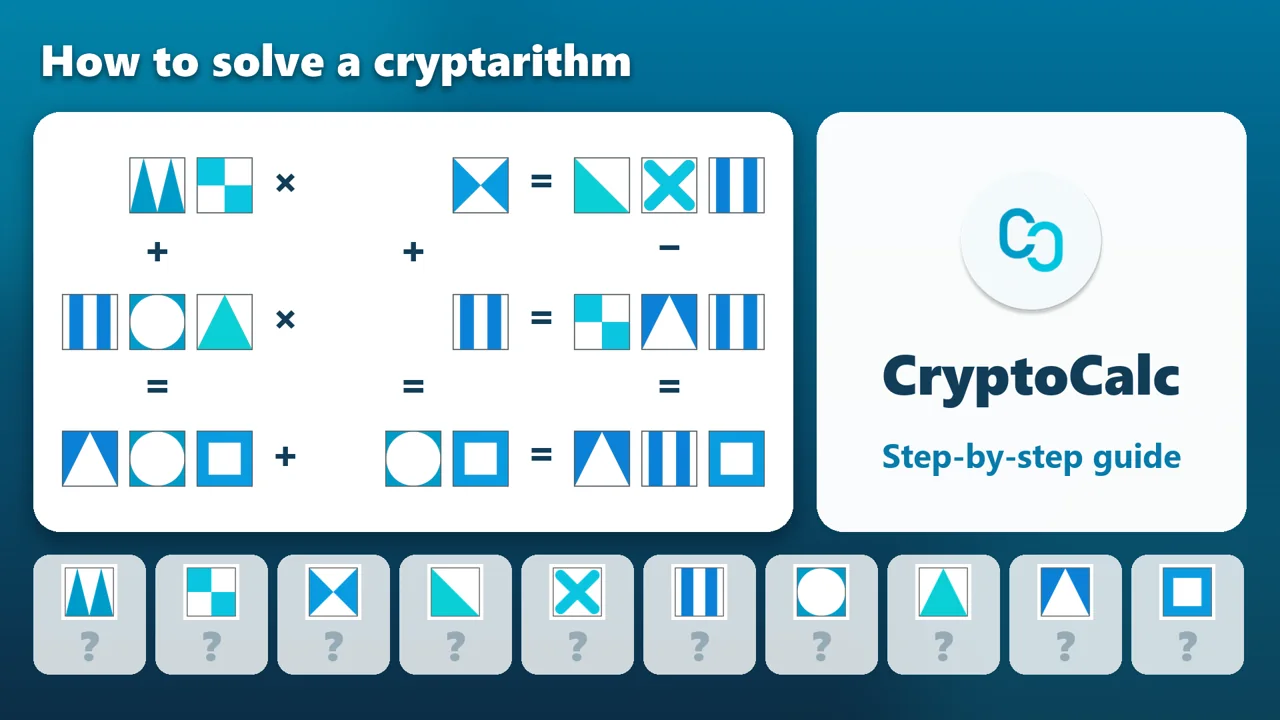
A cryptarithm is a math puzzle in which every symbol stands for a digit. Here six equations, three across and three down, must all work. You solve it with logic, not guesswork: this page shows you the method and a full worked example.
The rules
- Every symbol hides a digit, from 0 to 9.
- The same symbol is always the same digit; different symbols are different digits.
- Symbols side by side make a number, and the first digit of a number is never zero.
- The math works both across the three rows and down the three columns.
Where to start: the five clues
- Zero. If, in the last digits, a symbol added to itself gives itself, it is zero. Still in the last digits, the result of a digit minus itself is zero too. And if a sum ends with the same symbol as one of the numbers you add, the other number ends in zero.
- One. When the result of a sum has one digit more than the numbers you add, it starts with 1. And if a number is multiplied and stays the same, the other factor is 1.
- One digit at a time. Picture the equation as a column: look at the last digits first, then the tens, and remember what carries over.
- The math. When you know two numbers out of three in an equation, you can work out the third.
- Elimination. Each digit belongs to one symbol only: the more you find, the fewer are left to try.
A worked example, step by step
This is a Normal-level CryptoCalc puzzle. It uses all ten digits and has exactly one solution. Try it on your own first if you like, then follow the steps.
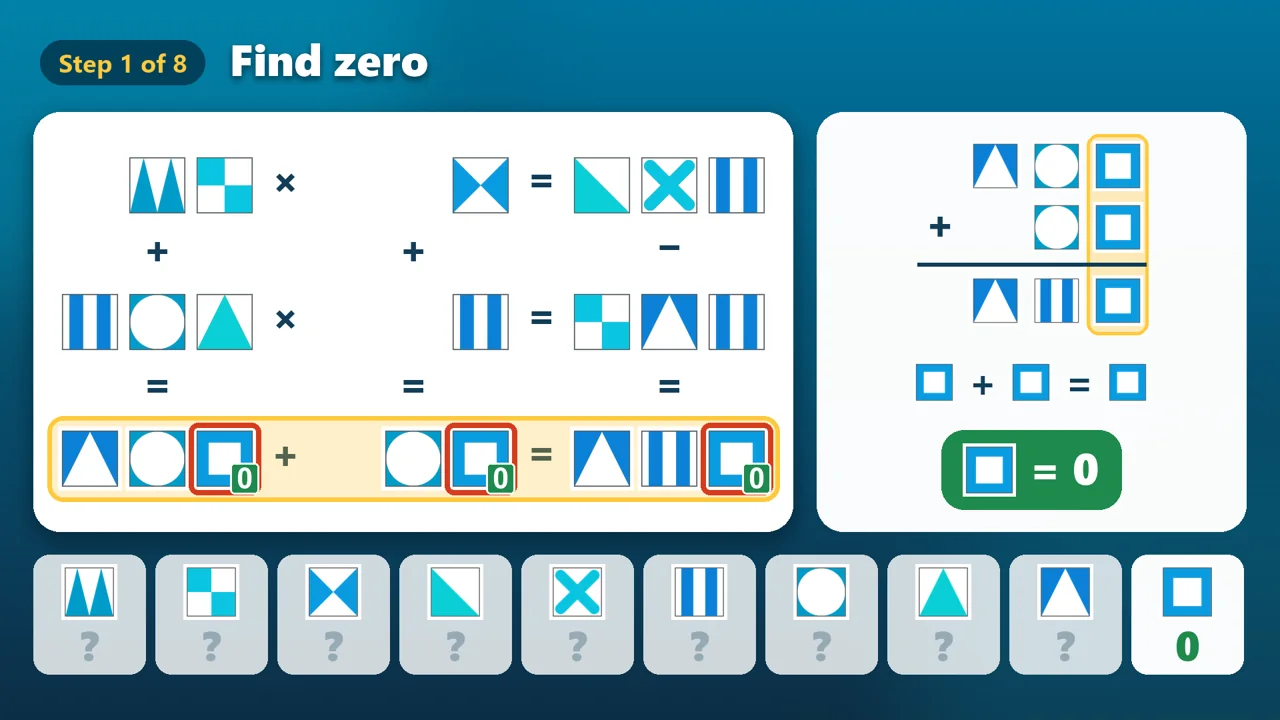
Step 1: find zero
Look at the bottom row, last digits only:  + gives again. Only one digit stays the same when you add it to itself: zero. So the square is 0.
There is a second clue: in the right column, again in the last digits,  − gives . A digit minus itself is zero.
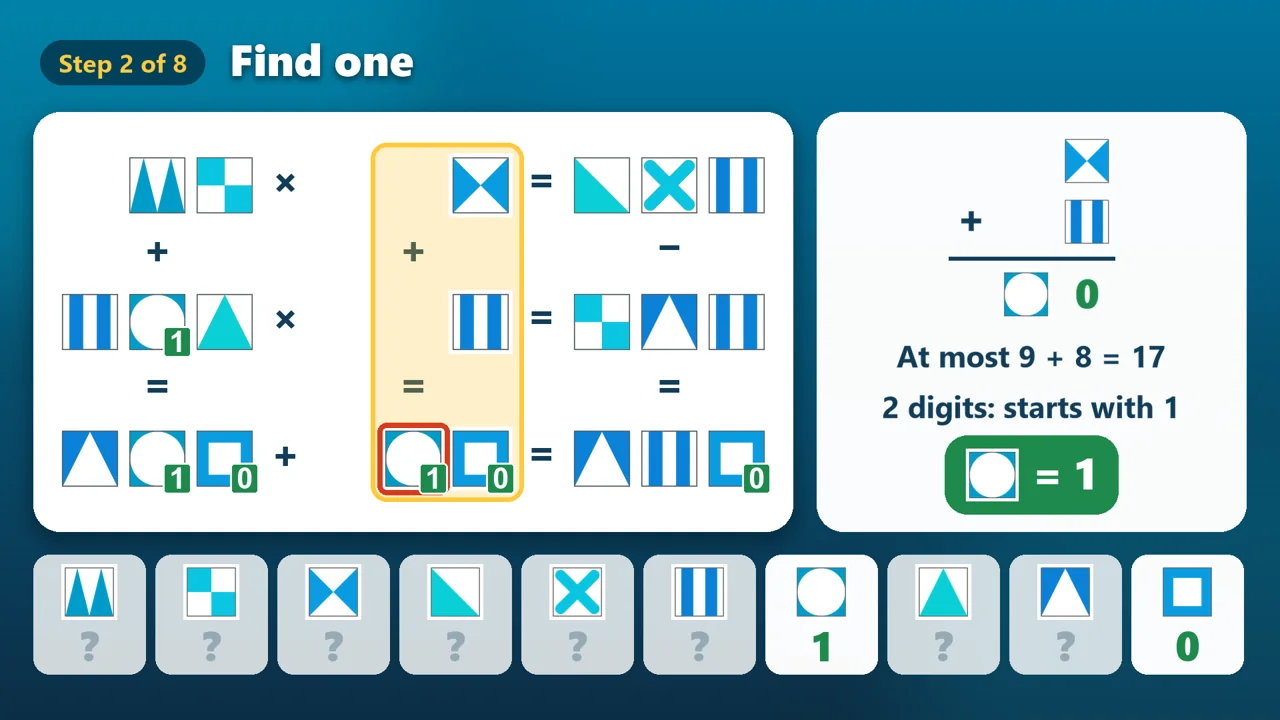
Step 2: find one
The middle column adds two single-digit numbers,  and . They are different digits, so the most they can make is 9 + 8 = 17. The result has two digits, so it must start with 1. The circle
 is 1.
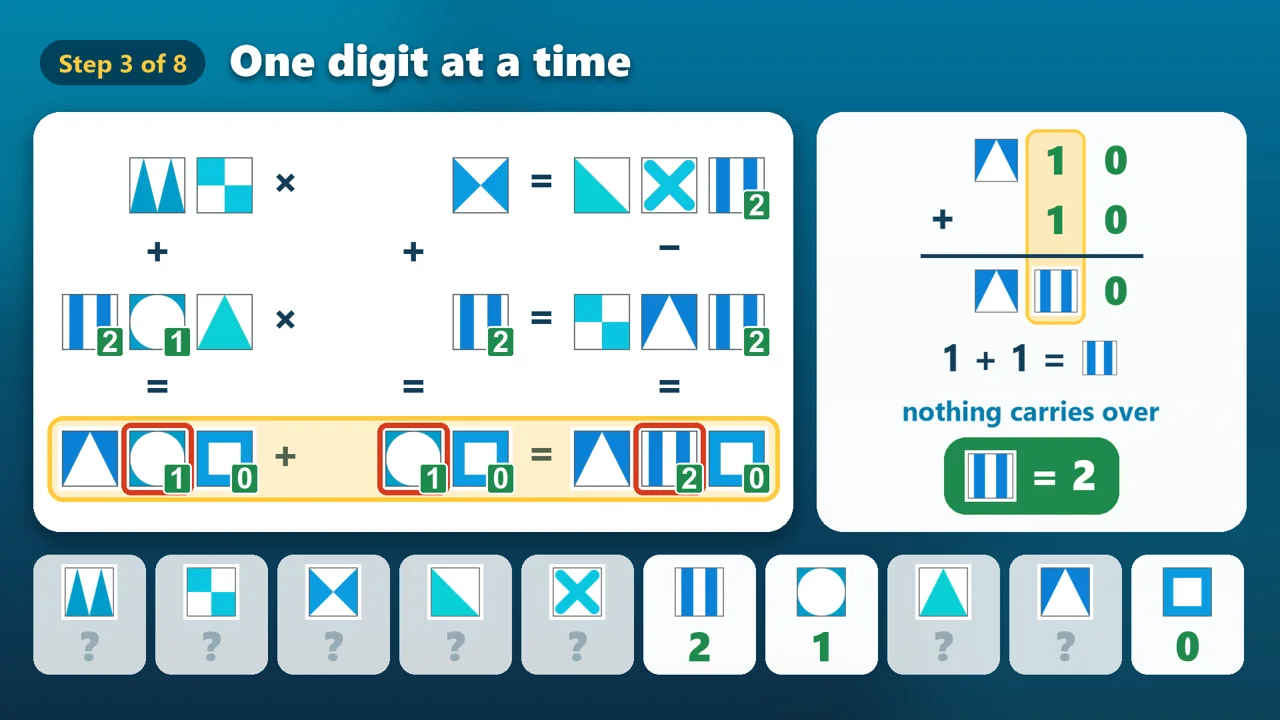
Step 3: one digit at a time
Back to the bottom row, now the tens: + = , that is 1 + 1. Nothing carries over from the last digits, because 0 + 0 = 0. The stripes are 2.
Step 4: complete the sum
Now only one symbol is missing in the middle column: + 2 = 10. The bow tie is 10 − 2 = 8.
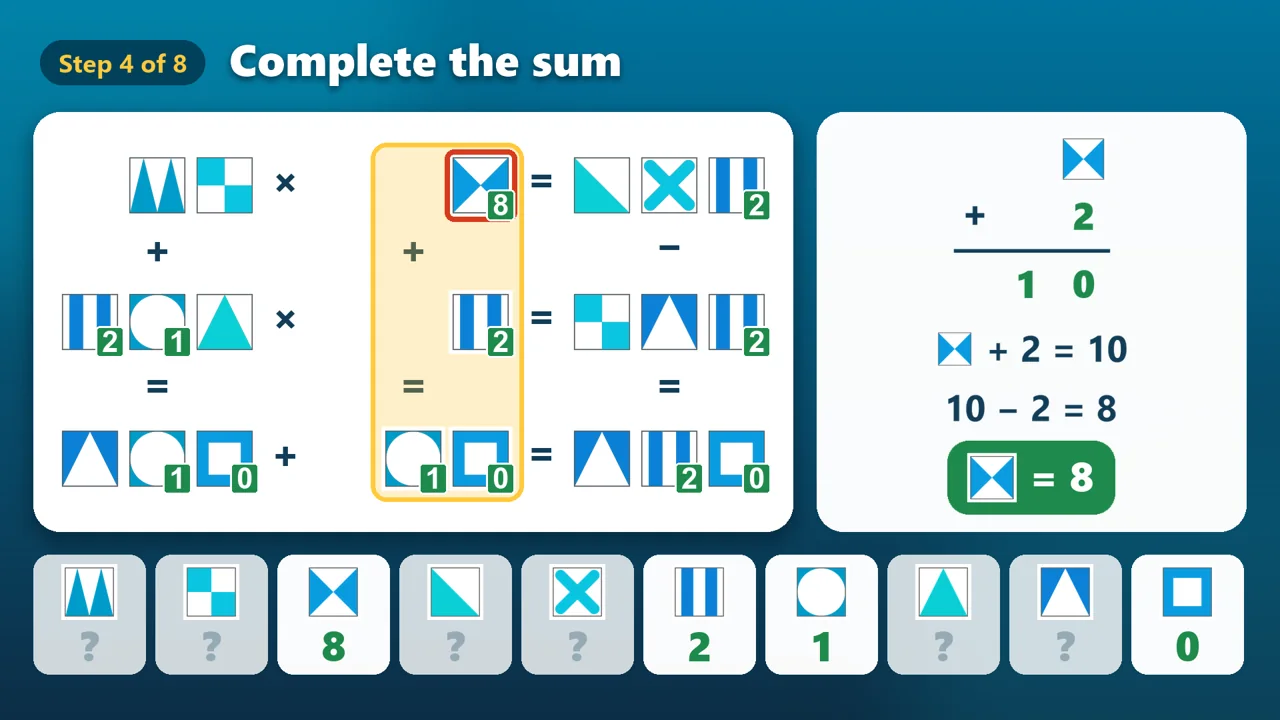
Step 5: check the last digit of the product
The middle row says that 21 × 2 ends in 2. Which digits end in 2 when you double them? Only 1 (1 × 2 = 2) and 6 (6 × 2 = 12). But 1 is already the circle, so the triangle is 6.
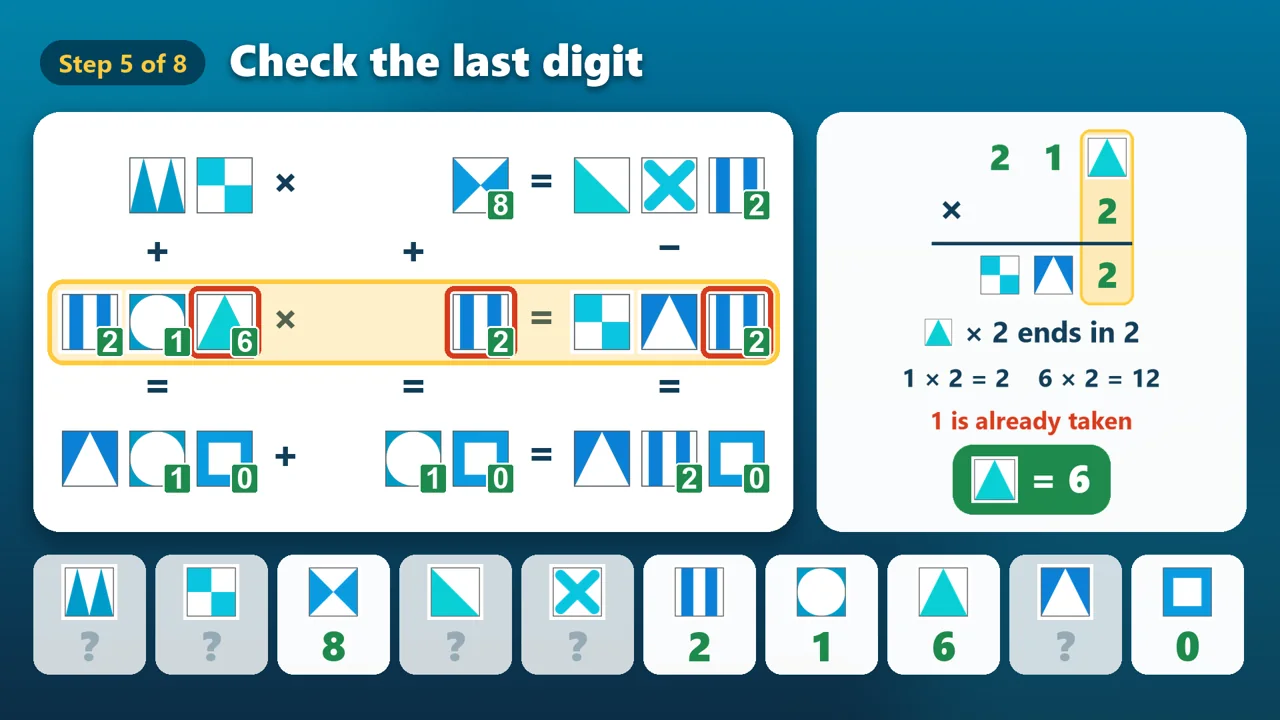
Step 6: multiply
216 × 2 = 432. The result was 
 , so in one go is 4 and is 3.
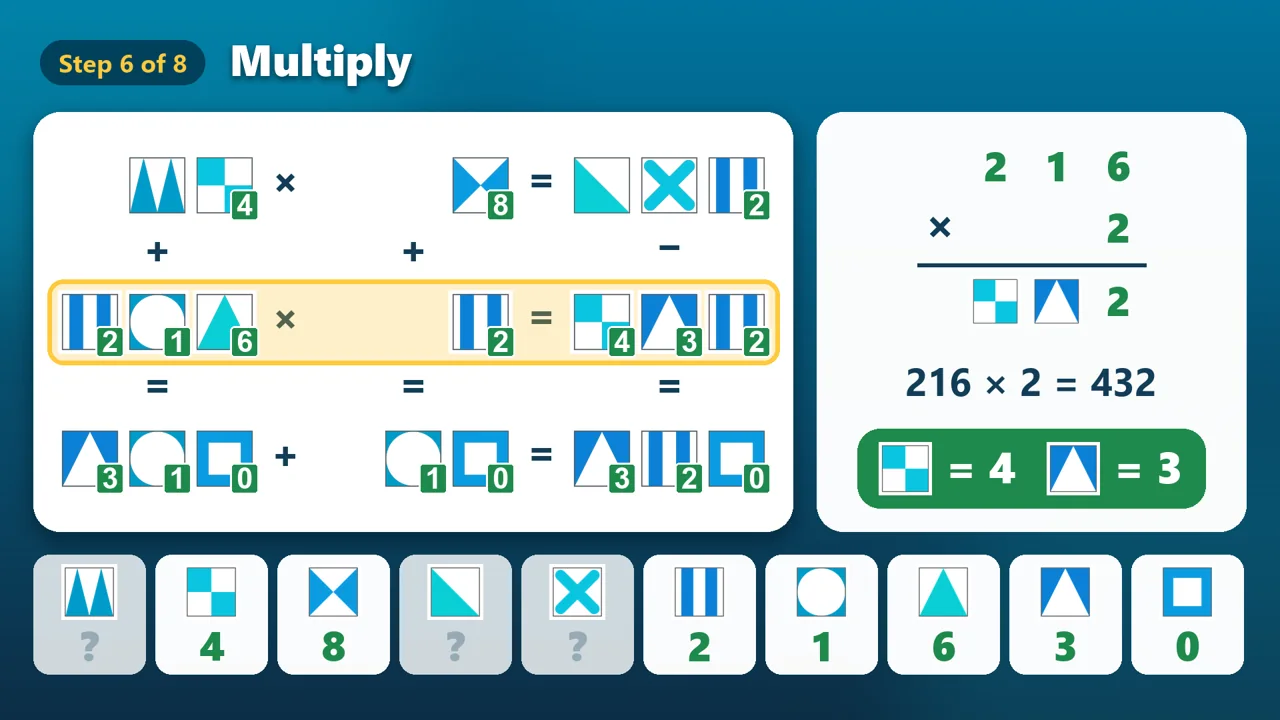
Step 7: subtract
The left column is  4 + 216 = 310. The missing number is 310 − 216 = 94, so is 9.
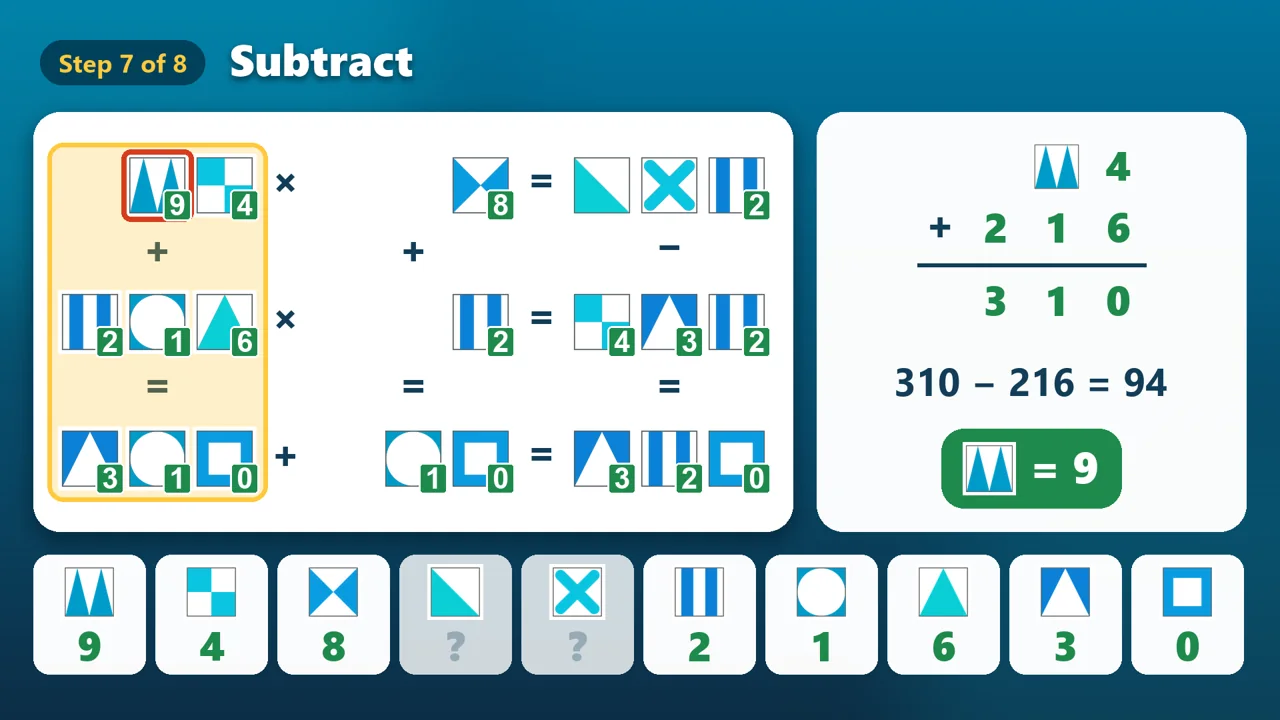
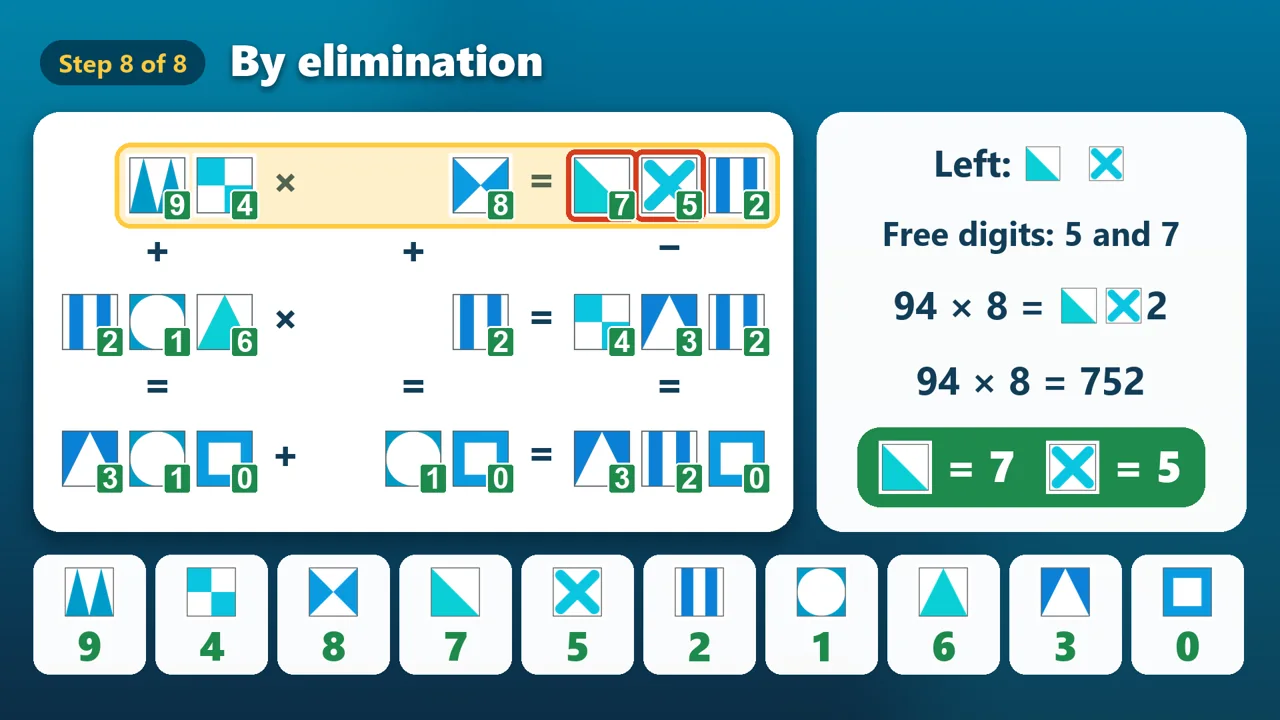
Step 8: by elimination
Two symbols are left,  and
 , and two free digits: 5 and 7. Which is which? The top row tells you: 94 × 8 = 752. So is 7 and is 5.
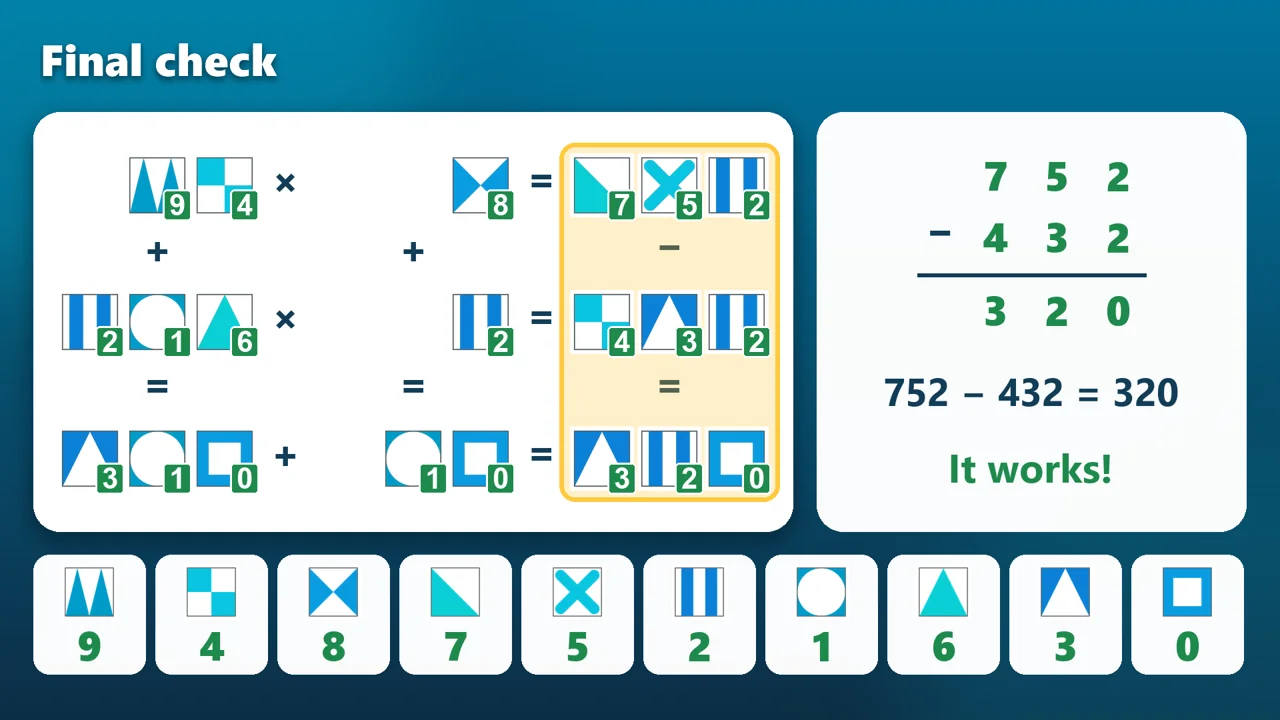
Final check
One equation has not been worked out yet, the right column: 752 − 432 = 320. Everything adds up, so the solution is correct.
Frequently asked questions
What is a cryptarithm?
It is a calculation in which letters or symbols replace the digits. The most famous one is SEND + MORE = MONEY, published by Henry Dudeney in 1924. In CryptoCalc the equations cross each other, like a crossword: three go across and three go down.
Do I need to be good at math?
No. The four basic operations and a little patience are enough: the fun part is the reasoning, not the arithmetic.
Can I use trial and error?
Sometimes you have to try two or three digits, but if you start from the right clues there are only a few left to try. The example on this page needs no guessing.
Where can I play for free online?
On the daily puzzle page: you play in your browser and the puzzle changes every midnight. The CryptoCalc app for Android has nearly 9,000 more, in three difficulty levels, free with ads.
Is it good for the classroom?
Yes: it trains mental arithmetic, column addition, carrying and reasoning by elimination. You can project the daily puzzle in class without installing anything.
Now it’s your turn
A new puzzle every day, the same for everyone. Play it free in your browser.